Stories and interviews
Submit
Info
Subscribe About Contact The Team
Online Exhibitions
Group Show 70: Under the Sun and the Moon Group Show 69: Photo for Non-Majors (part 2) Group Show 69: Photo for Non-Majors (part 1) Group Show 68: Four Degrees Group Show 67: Embracing Stillness Group Show 66: La Frontera Group Show 65: Two Way Lens Group Show 64: Tropes Gone Wild Group Show 63: Love, Actually Group Show 62: 100% Fun Group Show 61: Loss Group Show 60: Winter Pictures Group Show 59: Numerology Group Show 58: On Death Group Show 57: New Psychedelics Group Show 56: Source Material Group Show 55: Year in Reverse Group show 54: Seeing Sound Group Show 53: On Beauty Group Show 52: Alternative Facts Group Show 51: Future Isms Group Show 50: 'Roid Rage Group Show 48: Winter Pictures Group Show 47: Space Jamz group show 46: F*cked Up group show 45: New Jack City group show 44: Radical Color group show 43: TMWT group show 42: Occultisms group show 41: New Cats in Art Photography group show 40: #Latergram group show 39: Tough Turf P. 2/2 group show 39: Tough Turf P. 1/2

Humble Arts Foundation

New Photography
Stories and interviews
Submit
Info
Subscribe About Contact The Team
Online Exhibitions
Group Show 70: Under the Sun and the Moon Group Show 69: Photo for Non-Majors (part 2) Group Show 69: Photo for Non-Majors (part 1) Group Show 68: Four Degrees Group Show 67: Embracing Stillness Group Show 66: La Frontera Group Show 65: Two Way Lens Group Show 64: Tropes Gone Wild Group Show 63: Love, Actually Group Show 62: 100% Fun Group Show 61: Loss Group Show 60: Winter Pictures Group Show 59: Numerology Group Show 58: On Death Group Show 57: New Psychedelics Group Show 56: Source Material Group Show 55: Year in Reverse Group show 54: Seeing Sound Group Show 53: On Beauty Group Show 52: Alternative Facts Group Show 51: Future Isms Group Show 50: 'Roid Rage Group Show 48: Winter Pictures Group Show 47: Space Jamz group show 46: F*cked Up group show 45: New Jack City group show 44: Radical Color group show 43: TMWT group show 42: Occultisms group show 41: New Cats in Art Photography group show 40: #Latergram group show 39: Tough Turf P. 2/2 group show 39: Tough Turf P. 1/2
© Sameer Raichur

© Sameer Raichur

One Photographer’s Portrait of Social Isolation in Bangalore India

Sameer Raichur’s diaristic photographs of life during quarantine find new meaning in the everyday.

In May 2020, Sameer Raichur's photo of a backlit and silhouetted figure standing between a floral curtain and a window stopped me in my daily, quarantined Instagram doom scroll. The curtain, billowed by a breeze, seemed inhabited by a ghost. It’s the type of dark, whispy photo that Instagram’s algorithm loves, but goes beyond a tropey reference to the obvious existential metaphors one might associate with Kevin Spacey’s film “American Beauty,” and into something more authentically self-reflective. Tenderness, fear, isolation, and so many more emotions neatly – but not too neatly - rolled into a single photograph.

Raichur's caption reflects the image's vulnerability, uncertainty, and softness. “Life seems to have settled into a rhythm during lockdown. A usual day involves visiting the same spots in the house and at particular times, chasing the light,” the photographer notes. For Raichur, it became an ongoing struggle against meaninglessness, a celebration of the moments that might not have registered in previous times.
“Checking on pigeons hanging out on the edges of our windows,” Raichur writes, “watching my curtain blowing in the wind and endless staring out of balconies and windows, praying for the unexpected.”

This is but one image in a series that illustrates Raichur’s often hallucinatory visual response to isolation. It brought up childhood memories, reexaminations of family life, and newfound pleasures in the simple joys he might not have appreciated otherwise. Nearly a year into lockdown, I connected with Raichur to learn more about how he uses photography to cope and stay balanced.

Jon Feinstein in conversation with Sameer Raichur

Read more …
PostedMarch 2, 2021
AuthorJon Feinstein
CategoriesArtists, interviews
TagsSameer Raichur, quarantine in India, Covid photography, introspective photography, self-portraiture, new photography, photography and social isolation, photography about stillness
No Cars Go © Kriss Munsya from The Eraser

No Cars Go © Kriss Munsya from The Eraser

How Bold Colors and Floral Arrangements Can Symbolize Guilt, Pain, and Resolution

Kriss Munsya's ongoing photographic series The Eraser uses stylized tableaus and long-form poetic captions to reflect, erase, and resolve longstanding trauma.

At first glance, Kriss Munsya's highly stylized narrative portraits might come across as fashion editorials. A family basking in bright LA-feeling light, their faces obscured by flowers. A figure lying across a mid-century modern cabinet. A closeup of a face bedazzled in reflective circles. A car broken down in a parking lot, yet lit immaculately and also covered in elaborate floral arrangements. But there's a deeper story here. One seeped in pain, doubt, guilt, and an ongoing burden of racism – and trying to erase it.

Kriss Munsya was born in the Democratic Republic of Congo and moved to Belgium at an early age where he felt othered by the white community, yet developed a sense of guilt for having a limited number of Black friends, and never dating Black women. Munsya channels these feelings into colorful pastiches that borrow and remix his memories, pairing them with long-form part-biographical, part-fiction narrative captions (which we’ve included below,) written in the third person to help him process it all.

A longtime fan of his work on Instagram, I connected with Munsya amidst his two latest exhibitions – up through the end of February in Vancouver, BC at Pendulum Gallery and online at Oarbt.

Jon Feinstein in conversation with Kriss Munsya

Read more …
PostedFebruary 18, 2021
AuthorJon Feinstein
CategoriesArtists, Exhibitions, interviews
TagsKriss Munsya, Vancouver Artists, The Eraser, contemporary portraiture, contemporary photographic portraiture
No Longer Peter Cohen’s Property #16, 2020 © Alayna Pernell

No Longer Peter Cohen’s Property #16, 2020 © Alayna Pernell

Ancestral Connection, Care, Representation and the Power of the Archive

Working with materials dating back to the 19th century, artist Alayna Pernell digs into institutional archives to examine how Black identity is often erased, and how care extends to both images and individuals.

An MFA candidate at the School of the Art Institute of Chicago, Pernell’s research-based project began at home. Her family maintains a visual archive - everything from stately studio portraits to candid snapshots of life’s milestone moments - that reaches back to the 19th century. Such photographic continuity encapsulates a desire for familial and community connections that, for far too many Black Americans, was interrupted by the horrors that unfolded during Reconstruction and after.

Quoted in a 2019 smithsonianmag.org piece, author Laura Coyle elegantly sums it up: “For the African American community, photography was particularly important, because when they were in control of the camera, they had a chance to shape their own image for themselves, for their community and for the outside world in a way they normally didn’t have a chance to do in society.”

Our Mothers’ Gardens addresses representation and erasure within an institutional context. Pernell’s search for photographs of Black women in collections held by the Art Institute of Chicago and Museum of Contemporary Photography reveals the terms under which such images were collected, and how frequently the images do not include sitters’ basic identifying information.

Pernell cannot correct that shameful, all-too-familiar erasure. But, physical intervention – the way her hands frame and shield the figures – reads as a protective and loving gesture for those unnamed ancestors.

I contacted Alayna after seeing her shared via @saicphotography as she was awarded the 2020-2021 James Weinstein Memorial Fellowship. Read on to learn more about looking at her family archives, and how that influences notions of photographic representation and care for Black women.

Roula Seikaly in conversation with Alayna Pernell

Read more …
PostedFebruary 11, 2021
AuthorRoula Seikaly
CategoriesGalleries, Artists, interviews
Tagsvernacular photography, Peter Cohen archive, Alayna Pernell, photographic archives, photography collections, race and gender in photography, photography and Black identity
Maurice Berger and Marvin Heiferman in 1997. Portrait by Mitch Epstein

Maurice Berger and Marvin Heiferman in 1997. Portrait by Mitch Epstein

Marvin Heiferman on Photography, Love, and the Loss of Maurice Berger

Approaching the one-year anniversary of Maurice Berger’s COVID-related death, his husband, photography curator and critic Marvin Heiferman speaks about their shared passion for photography, social justice, the ubiquity of image-culture, and life itself.

Early in the COVID pandemic, the photo community lost one of its brightest lights. In late March 2020, writer, curator, and staunch social justice advocate Maurice Berger died at his home in Craryville, New York.

Berger’s 1990 Art in America essay “Are Art Museums Racist?” helped contextualize contemporaneous conversations about race and representation across the art world, but specifically in institutions that predictably fail to acknowledge and correct racist practices and procedures. From 2013 through 2019, Berger’s award-winning column, Race Stories, for the New York Times Lens Blog championed the photographic works, books, and projects of people of color.

Berger’s premature death opened a gaping hole in the lives of those who knew or admired him, but none wider than his husband Marvin Heiferman.

An equally revered writer and cultural commentator, Heiferman started sharing candid visual reflections on Instagram via @whywelook shortly after Berger’s death. Photos of life with Maurice, and without him, convey harrowing loss as adequately as images can. Their wedding rings stamped with “Love Mo, Love Marvin.”
A photo of Maurice’s favorite plaid vest captioned “An easy picture to make, but so sad for me to look at…” Marvin’s first view into the couple’s New York City apartment after Maurice died. These pictures frame social media and photography as spaces for processing grief and engaging community.

Marvin Heiferman graciously agreed to speak with me about his loss, and how he is coping nearly a year on.

Roula Seikaly in conversation with Marvin Heiferman

Read more …
PostedFebruary 8, 2021
AuthorRoula Seikaly
Categoriesinterviews
TagsMaurice Berger, photography and death, Marvin Heiferman, photography and social justice, contemporary photography, Covid and the photo community, photography and grief, photography and mourning
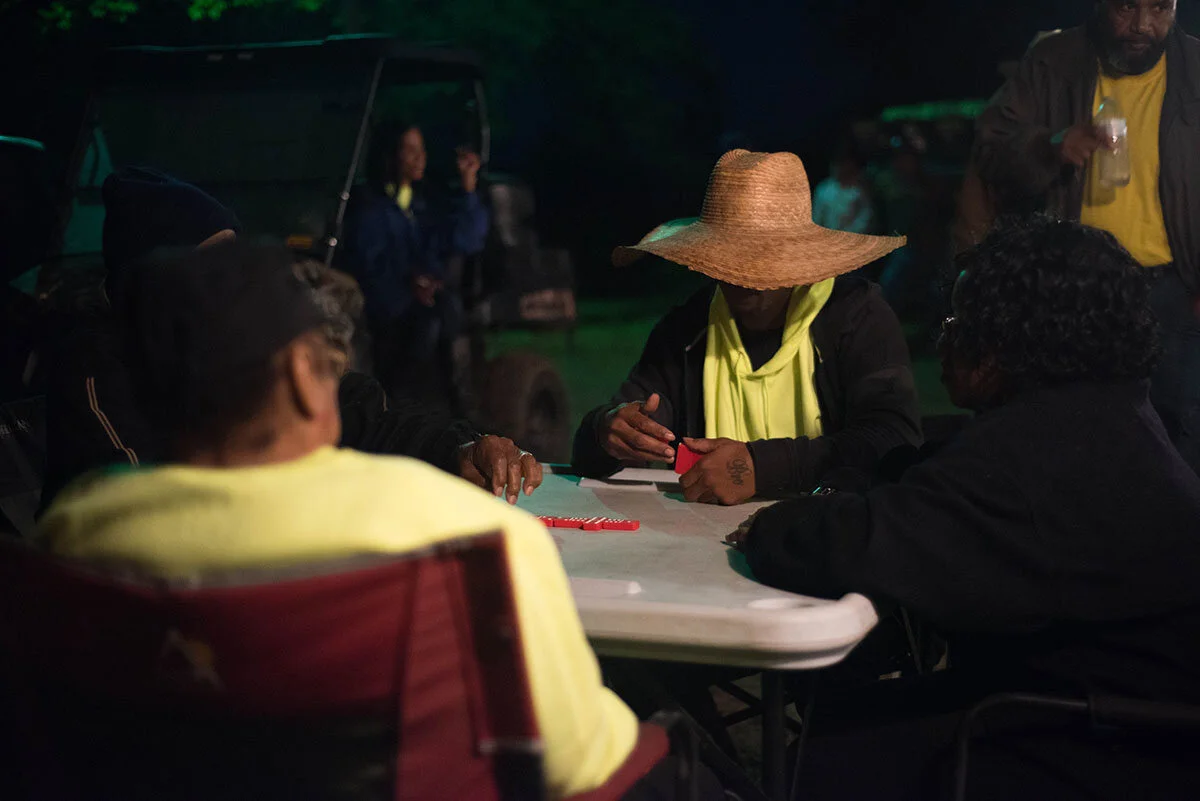
Domino Game, 2018 © Jamie Robertson

Domino Game, 2018 © Jamie Robertson

An Autobiographical Photobook on Black Life in Leon County, Texas 

Jamie Robertson uses her family history to reconcile wider narratives around the African Diaspora in her new book from Fifth Wheel Press, Charting the Afriscape of Leon County.

Robertson pairs images from her childhood and family archive with new landscape photographs and tableaux, and text, often from her family mythos and West African cosmologies, giving her images greater context.

A darkly lit yet highly saturated photograph of domino players, their faces obscured by shadow and a wide-brimmed straw hat on one page, a 1980s family reunion snapshot on the other. Dominos, a constant in her family history, symbolize generational ties, traditions, and holding fast to cultural and family evolutions.

In another pairing, Robertson re-photographs a landscape on her family’s property originally depicted in an image from her family's archive, the new image in conversation with the original on an opposite page. Instead of approaching the two photos as a “then and now” typology, the new photograph takes on a spiritual aspect. The pairing becomes a personal meditation on how we remember a place, and the potential for spirituality to soak into its memory.

Charting the Afriscape of Leon County, Texas highlights and centers the importance and continuity of Black life, spirituality, and its intersection with the land throughout Robertson’s lineage and creative practice.

We recently spoke about Robertson’s work, her family history, and the process of publishing a book during a pandemic. (Humble editor’s note: this book is being printed in a limited 1st edition of 50 copies - if you’re at all considering purchasing one, we highly recommend acting on that consideration soon.)

Jon Feinstein in conversation with Jamie Robertson

Read more …
PostedFebruary 4, 2021
AuthorJon Feinstein
Categoriesinterviews, Artists, Art News, Photobooks, Publications, Vernacular Photography
TagsJamie Robertson, Fifth Wheel Press, Charting The Afriscape of Leon County Texas, African Diaspora, Diaspora Studies, West African Cosmology
Newer / Older

Founded in 2005, Humble Arts Foundation is dedicated to supporting and promoting new art photography.